Author: Madeline Rihn
Within the past fifty years, the fashion industry has been subject to a number of revolutionary innovations in production. Take, for example, the Spinning Jenny, a multi-spindle spinning machine for wool and cotton, patented in 1770 and one of the key factors in the industrialization of the textile industry. Or the sewing machine, a staple in fashion manufacturing by the 1800s, used to mass-produce clothing at a scale vastly unheard of just fifty years before then. And lastly, automated sewing and weaving, a form of technology now commonplace in 21st century manufacturing, further efficiating the fashion industry to the scale as is today.
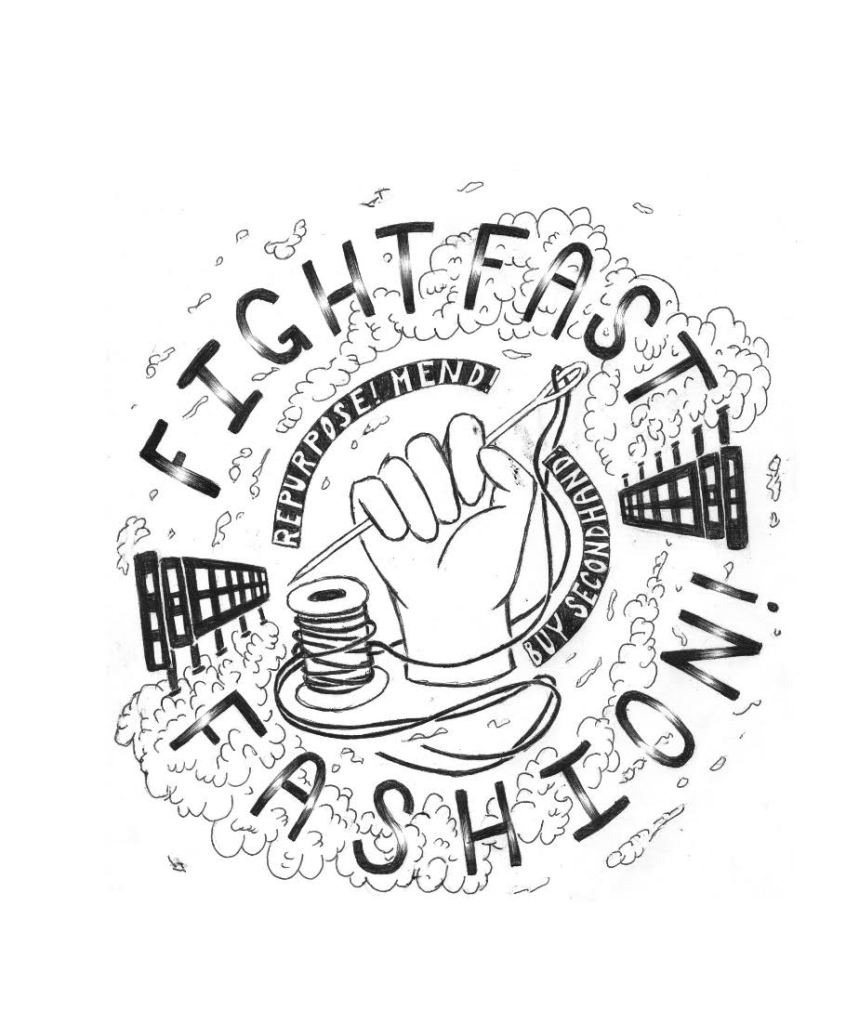
But despite the low costs, speedy manufacturing, and high profit margin of technological innovations, the drive for profit within the fashion industry does not come without blood. In 1911, a fire in New York’s Triangle Shirtwaist Factory, killing 146 workers. Parallels to this event are commonplace throughout history and in the present day; in 2012, a fire at the Tazreen Fashion Factory in Bangladesh killed at least 117 workers. This kind of violence and disaster is systematic to what we now call the fast fashion industry.
Merriam-Webster defines the term fast fashion as “an approach to the design, creation, and marketing of clothing fashions that emphasizes making fashion trends quickly and cheaply available to consumers.” In other words, fast fashion companies such as H&M, Zara, and Forever21 follow a low quality/high volume business model, cutting costs on production and materials in order to sell more and more items to the consumer. It is an industry driven by a goal of maximum output and thus, maximum profit, and it shows: the former CEO of H&M, Stefan Perrson, is worth $19 billion. Amancio Ortega, founder of Zara, is worth $69.7 billion.
The fashion industry hasn’t always been like this. Before the 20th century, and even just in the past 50 years, the norm for the fashion industry was running on two seasons a year: spring/summer and fall/winter. Now, many industry professionals note the existence of at least 52 “micro-seasons” a year, with new styles and collections unveiled by companies every week to keep up with rapidly changing fashion trends.
The low cost of fast fashion is undoubtedly paid for elsewhere, most notably within the realm of labor rights and environmental issues. A larger output of clothing means that clothing is lower quality, leading to increasingly greater outputs of waste; it is estimated that Americans dispose of about 12.8 million tons of textiles each year. In order to keep costs low, most textile production is outsourced, where manufacturing is marked by low wages, poor working conditions, and even child labor.
- The Editors of Encyclopaedia Britannica. “Spinning Jenny.” Encyclopædia Britannica, Encyclopædia Britannica, Inc., 7 Aug. 2019, www.britannica.com/technology/spinning-jenny.
- Idacavage, Sara. “Fashion History Lesson: The Origins of Fast Fashion.” Fashionista, Fashionista, 8 June 2016, fashionista.com/2016/06/what-is-fast-fashion.
- Lohr, Shannon Whitehead. “5 Truths the Fast Fashion Industry Doesn’t Want You to Know.” HuffPost, HuffPost, 19 Oct. 2014, www.huffpost.com/entry/5-truths-the-fast-fashion_b_5690575.
- Reid, Lindsey. “Fast-Fashion: Unethical and Unsustainable.” UAB Institute for Human Rights Blog, University of Alabama at Birmingham, 24 Oct. 2018, cas.uab.edu/humanrights/2018/04/26/fast-fashion-unethical-and-unsustainable/.
- Schlossberg, Tatiana. “How Fast Fashion Is Destroying the Planet.” The New York Times, The New York Times, 3 Sept. 2019, www.nytimes.com/2019/09/03/books/review/how-fast-fashion-is-destroying-the-planet.html.
- Stafford, Victoria. “How Fast Fashion Hurts Workers.” Green America, 8 Aug. 2018, www.greenamerica.org/blog/factory-exploitation-and-fast-fashion-machine.
- Stanton, Audrey. “What Is Fast Fashion, Anyway?” The Good Trade, The Good Trade, 8 Oct. 2018, www.thegoodtrade.com/features/what-is-fast-fashion.
- Zarroli, Jim. “In Trendy World Of Fast Fashion, Styles Aren’t Made To Last.” NPR, NPR, 11 Mar. 2013, www.npr.org/2013/03/11/174013774/in-trendy-world-of-fast-fashion-styles-arent-made-to-last.
 Facing Fast Fashion