Featured

The Devil Wears Zara, Not Prada

Author: Madeline Rihn

Within the past fifty years, the fashion industry has been subject to a number of revolutionary innovations in production. Take, for example, the Spinning Jenny, a multi-spindle spinning machine for wool and cotton, patented in 1770 and one of the key factors in the industrialization of the textile industry. Or the sewing machine, a staple in fashion manufacturing by the 1800s, used to mass-produce clothing at a scale vastly unheard of just fifty years before then. And lastly, automated sewing and weaving, a form of technology now commonplace in 21st century manufacturing, further efficiating the fashion industry to the scale as is today.
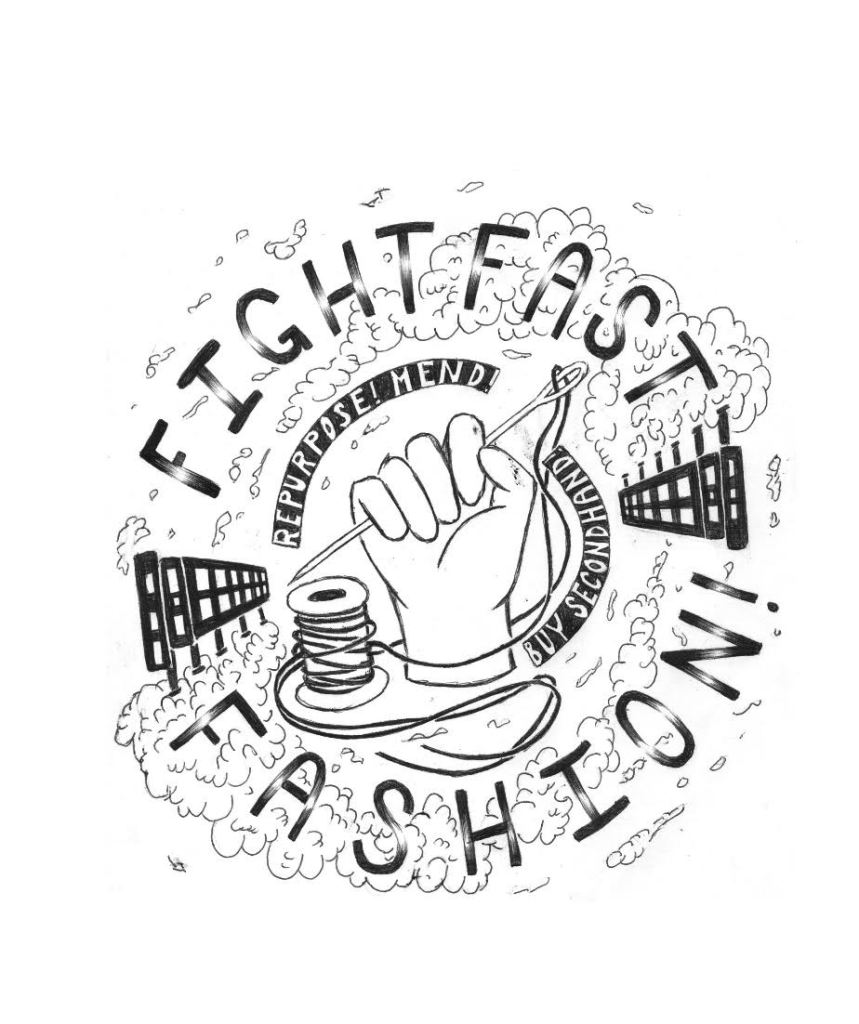
But despite the low costs, speedy manufacturing, and high profit margin of technological innovations, the drive for profit within the fashion industry does not come without blood. In 1911, a fire in New York’s Triangle Shirtwaist Factory, killing 146 workers. Parallels to this event are commonplace throughout history and in the present day; in 2012, a fire at the Tazreen Fashion Factory in Bangladesh killed at least 117 workers. This kind of violence and disaster is systematic to what we now call the fast fashion industry.

Merriam-Webster defines the term fast fashion as “an approach to the design, creation, and marketing of clothing fashions that emphasizes making fashion trends quickly and cheaply available to consumers.” In other words, fast fashion companies such as H&M, Zara, and Forever21 follow a low quality/high volume business model, cutting costs on production and materials in order to sell more and more items to the consumer. It is an industry driven by a goal of maximum output and thus, maximum profit, and it shows: the former CEO of H&M, Stefan Perrson, is worth $19 billion. Amancio Ortega, founder of Zara, is worth $69.7 billion. 

The fashion industry hasn’t always been like this. Before the 20th century, and even just in the past 50 years, the norm for the fashion industry was running on two seasons a year: spring/summer and fall/winter. Now, many industry professionals note the existence of at least 52 “micro-seasons” a year, with new styles and collections unveiled by companies every week to keep up with rapidly changing fashion trends. 

The low cost of fast fashion is undoubtedly paid for elsewhere, most notably within the realm of labor rights and environmental issues. A larger output of clothing means that clothing is lower quality, leading to increasingly greater outputs of waste; it is estimated that Americans dispose of about 12.8 million tons of textiles each year. In order to keep costs low, most textile production is outsourced, where manufacturing is marked by low wages, poor working conditions, and even child labor. 

  1. The Editors of Encyclopaedia Britannica. “Spinning Jenny.” Encyclopædia Britannica, Encyclopædia Britannica, Inc., 7 Aug. 2019, www.britannica.com/technology/spinning-jenny.
  2. Idacavage, Sara. “Fashion History Lesson: The Origins of Fast Fashion.” Fashionista, Fashionista, 8 June 2016, fashionista.com/2016/06/what-is-fast-fashion.
  3. Lohr, Shannon Whitehead. “5 Truths the Fast Fashion Industry Doesn’t Want You to Know.” HuffPost, HuffPost, 19 Oct. 2014, www.huffpost.com/entry/5-truths-the-fast-fashion_b_5690575.
  4. Reid, Lindsey. “Fast-Fashion: Unethical and Unsustainable.” UAB Institute for Human Rights Blog, University of Alabama at Birmingham, 24 Oct. 2018, cas.uab.edu/humanrights/2018/04/26/fast-fashion-unethical-and-unsustainable/.
  5. Schlossberg, Tatiana. “How Fast Fashion Is Destroying the Planet.” The New York Times, The New York Times, 3 Sept. 2019, www.nytimes.com/2019/09/03/books/review/how-fast-fashion-is-destroying-the-planet.html.
  6. Stafford, Victoria. “How Fast Fashion Hurts Workers.” Green America, 8 Aug. 2018, www.greenamerica.org/blog/factory-exploitation-and-fast-fashion-machine.
  7. Stanton, Audrey. “What Is Fast Fashion, Anyway?” The Good Trade, The Good Trade, 8 Oct. 2018, www.thegoodtrade.com/features/what-is-fast-fashion.
  8. Zarroli, Jim. “In Trendy World Of Fast Fashion, Styles Aren’t Made To Last.” NPR, NPR, 11 Mar. 2013, www.npr.org/2013/03/11/174013774/in-trendy-world-of-fast-fashion-styles-arent-made-to-last.


Featured

US and the Sweatshop Factory

Author: Penny Saltzman

Browsing the racks and shelves of any goodwill or second-hand store, lends itself to the overwhelming presence of pieces from fast fashion companies. Forever 21, H&M, Abercrombie, and almost any other brand you can think of is most likely a product of the fast fashion industry. To refresh, fast fashion is a dual meaning term for what designers intend to be in style for a very short time, yet also what we end up throwing away after only a couple of uses. I thought that I was doing my part by not remembering the last time I had walked into a retail store. However, I now feel that without trying to que others into this issue, that I am merely a bystander to a much larger problem. This essay will outline who is impacted by fast fashion. Other than the environment, both the buyer and the manufacturers absorb the greatest harm. Fast fashion seems to thrive on a cycle of cheap material and labor costs. Even though people from a wide variety of socio-economic backgrounds benefit from fast fashion, people who do not have the means to afford “high fashion” often slip into supporting fast fashion. Further, people who cannot afford fast fashion end up supporting second hand options before they go to the mall. However, this string of logic is very hard to prove and support. A lot of the fast-fashion clothes that make it to Good Will have only been worn once or twice, hence why they are able to be re-sold. Eventually, the real pitfall is that these clothes will end up in the trash after very few uses. 

The most easy affect to draw upon is the workers that produce fast fashion. Starting in the cotton fields, we see workers in harsh farming conditions paid below minimum wage. After that, factory workers in developing countries work long hours performing tedious or non-stimulating tasks all so that a t-shirt saying “I hate Mondays” hits the racks. To unpack this in more detail, often times when we look at a tag on our clothing, we have no idea where it was produced, most likely if it is made anywhere other than the United States. Even US working conditions are flawed. The cost of living has risen while wages have remained largely static. In third world countries the same thing is happening, however, they are experiencing industrial growth at the same time. 

Essentially, anyone that handles the clothing, starting from the planting of cotton seeds to the weaving of textiles, is impacted by the process. As seen in the environmental impact section, the harm that fast fashion induces on people is equally induced on the environment. Privileged consumers of fast fashion can easily replace the item when they are done wearing it, others that cannot afford this may end up wearing it until they no longer can and then throwing it away. In either case, if the item rips beyond the point of repair, it will just end up in the trash. There is also an impact on the people who collect the trash and or have to sort the clothes at a Good Will or second hand store. This is often a minimum wage job where workers are on their feet, exposed to warehouse conditions. 

Featured

The Days After Tomorrow? It’ll Still Be Here.

Author: Soyeon Jang

What is the correlation between fashion and environment? Why do we need to care about it? Surprisingly, the fashion industry has a harmful impact on the environment. In fact, it is the second largest polluter in the world, right after the oil industry.

Water Pollution

In most of the countries where garments are produced, untreated toxic wastewater from factories dumped directly into the rivers. Wastewater contains toxic substances such as mercury, lead, arsenic, and more. These are terribly harmful for millions of people living near the river and the health of aquatic life. 

  • 20% of industrial water pollution comes from textile treatments and dying
  • 200,000 tons of dyes are lost to effluents every year
  • 90% of waste water in developing countries is discharged into rivers without treatment

Water Consumption

The fashion industry is a major water consumer. During dyeing and finishing process for clothes, it uses large quantity of fresh water. For example, it can take up to 200 tons of fresh water per ton of dyed fabric. Cotton is also a big factor to use large amounts of water. Nearly 20,000 liters of water are needed to produce just 1kg of cotton.

  • 1.5 trillion liters of water are used by the fashion industry every year
  • 200 tons of fresh water are needed to dye one ton of fabric
  • 750 million people in the world do not have access to drinking water

Greenhouse Gas Emission

The apparel industry emits a high quantity of greenhouse gases because of the energy used during its production, manufacturing, and transportation of millions of clothes consumed all around the world each year.

  • 23kg of greenhouse are generated for 1kg of fabric produced
  • 70 million oil barrels are used every year to produce polyester
  • 400% more carbon emissions are produced if we wear a cloth 5 times instead of 50 times

Microfibers in our Ocean

Every time we wash garment such as polyester and nylon, nearly 1,900 microfiber get released into the water, and goes into the ocean. These microfibers are ingested by small aquatic lives and  they are eaten by small fish. Small fishes are eaten by bigger fish and eventually microfibers will comeback as foods that we eat everyday.

  • 190,000 tons of textile micro plastic fibers end up in the oceans every year

Waste Accumulation

Large quantity of garments get wasted each year. As reference, a family in western world throws away an average of 30 kg of clothing every year. 72% of our garments are made out of synthetic fibers. Synthetic fibers such as polyester and nylons can take up to 200 years to decompose 

  • 15% of our clothing only are recycled or donated
  • 5.2% of the waste in our landfills are textiles
  • 3 years is the average lifetime of a garment
  1. “Reichart, Elizabeth, Deborah Drew. “By the Numbers: The Economic, Social and Environmental Impacts of Fast Fashion.” World Resource Institute, World Resource Institute, 10 Jan. 2019, https://www.wri.org/blog/2019/01/numbers-economic-social-and -environmental-impacts-fast-fashion
  2. “Fashion’s Environmental Impact,” sustainyourstyle.org, accessed November 1, 2019, https://www.sustainyourstyle.org/old-environmental-impacts

“For real, ask your grandpa, can I have his hand me downs?”

Author: Lauren Welch

While much of the problem with fast fashion is caused by big mass-producing corporations, we each can still do something to limit our personal contribution. Putting in the effort to make your closet more sustainable and humanely sourced is a way of living responsibly for our planet, and is not as hard as you might think. Here are some small changes you can make to help reduce fast fashion and its impacts.

Buy Less Clothes

When you look through your closet, you probably already notice several similar looking items. Maybe you have three slightly different long-sleeved white shirts, but feel like you can’t get rid of them because of course they give off different moods, or are for different weather, or whatever it may be. People who practice minimalism might have an easier time wrapping their heads around how easy it is to live with fewer options, but for the rest of us it’s difficult to not have tons to choose from each day. Outside of our closets, the market world gives us practically infinite choices for clothing as well.

Fighting the temptation to always have more choices and newer things is like fighting the urge to keep up with progress, and in an individualistic society this is nearly impossible. But the next time you go shopping, really try not to buy any clothing on a whim. Ask yourself these questions: Do I already have something similar? Will the people I know care if I’m wearing this piece vs another item I have? Will this clothing piece be worth the money and environmental impact it will have? Hopefully after taking these considerations, you’ll make wiser purchasing decisions.

Buy Second Hand

If you’re someone who takes joy in owning a wide variety of clothes and can’t imagine not having a constantly changing wardrobe, thrift shopping might be a great choice for you. Find your local thrift store and take some time to search for clothes that suit you, and you’ll be filling your want for new things while also preventing clothes from ending up in a landfill. Nowadays, thrift shopping is more popular than ever, with a whole new genre of fashion being “Modern Thrift,” so it just takes a creative eye to see how you can make cool outfits that are still trendy with second-hand items. There are even thrifting apps nowadays, such as Depop™ and Ebay™, where you can buy from home and sort through options faster virtually. Be aware that when you order anything from online, the packaging and carbon emission from shipping has its own environmental impact as well, but there are often options to limit this. For example, you can sign up for “frustration-free packaging” on Amazon (which also sells used items), an initiative to reduce excessive packaging1.

Host a Clothing Swap or Upcycle

If you want some free new items, get a group of friends or associates together and bring your unwanted items, then do a trade-off. Even if you can’t find anything you like, you might be able to get rid of some things you didn’t want without throwing them away or donating them. There are also plenty of great tutorials online for how to creatively upcycle clothes to make them trendier or less drab. You could have a get-together where you and some friends upcycle your clothes together for a crafty night. For instance, you could follow a tutorial to make your boring tees into cute crop tops.

Do Research

Finally, if you do decide to continue buying clothes like normal, make sure you do a little research to make informed decisions about your purchases. Research to see if the companies or brands your buying from are made locally or abroad, and look into the working conditions of the factories where they produce. Check to see if the clothes you’re looking at are made from sustainable materials. Avoid nylon and polyester materials, as these ingredients are non-biodegradable2 and not sustainably produced, and therefore will have a larger environmental impact. If you buy online, look up the Sustainable Apparel Coalition and access information on the company’s environmental impact1. And when you but clothes, think about how long it will last, and if it’s made from sturdy materials or has a classic design that you think you can wear for many years to come.

  1. Osmanski, Stephanie. “Shopping for Sustainable Clothing 101.” Green Matters, Green Matters, 4 Jan. 2019, https://www.greenmatters.com/style/2019/01/04/bfnS6tD/ shopping-for-sustainable-clothing.
  2. Issi. “Environmental Impacts.” Green Choices, Green Choices, 19 Apr. 2018, https://www.greenchoices.org/green-living/clothes/environmental-impacts
Create your own website, free on WordPress.com.Create your own website.
Start free